
If you've ever spec'd a hinge for a lid, panel, or enclosure and then watched a user struggle to lift it — or worse, seen it slam shut on someone's fingers — you already know that "friction hinge" is not a one-size-fits-all part. The same 30 cm lid can feel effortless or exhausting depending entirely on which of the four common hinge types sits under the hood.
We ran the numbers on all four. Below is the full breakdown: the formulas, the assumptions, the actual kgf values at 0°, 45°, and 90° of opening — and, more importantly, which type you should actually be pulling up in your CAD software depending on what you're designing.
A quick note on terms before we start: "friction hinge" and "torque hinge" are used almost interchangeably in the industry (Southco, Reell, and most Asian manufacturers switch between the two depending on the market), and we'll do the same throughout this article.
Why "Opening Force" Isn't Just About the Hinge
Before comparing hinge types, it helps to understand what's actually fighting against the user's hand. Two forces are in play every time someone lifts a hinged lid:
- Gravitational torque — the lid's own weight, pulling it back down. This is fixed by your product's geometry and material, not by the hinge.
- Hinge friction torque — the resistance built into the hinge mechanism itself, which is what you can control by choosing a different hinge type.
The hinge's job is to balance these two forces just enough that the lid stays put at any angle, without requiring a wrestling match to move it. Get the friction torque too low, and the lid flops open or drifts shut on its own. Too high, and your user gives up trying to open it one-handed.
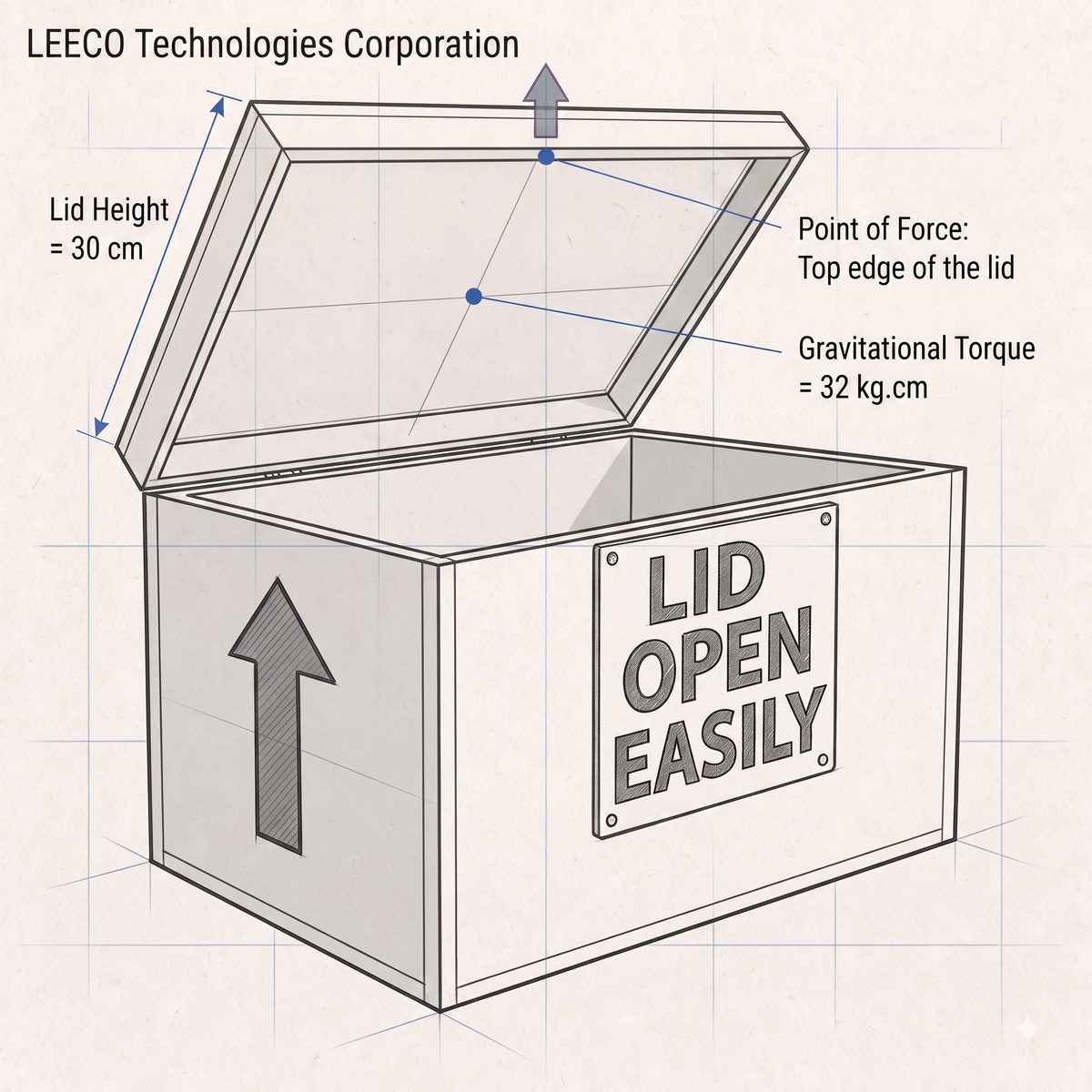
For this analysis, we used the following constants, representative of a mid-size enclosure lid (think server rack door, medical cart panel, or laptop-style cover):
| Lid Height (Lever Arm) | 30 cm |
| Minimum Torque to Support the Lid (Gravitational Torque) | 32 kg·cm |
| Point of Force Application | Top edge of the lid |
Gravitational torque is modeled as scaling with cos(angle), reflecting how the lid's center-of-mass moment arm shrinks as it rotates from flat (0°, maximum torque) toward vertical (90°, where gravity contributes essentially nothing). The hinge's own friction torque is treated as constant across the full swing — a simplification that holds reasonably well for most cam and friction-clutch hinges, though real-world torque can drift slightly with speed and wear.
The Four Friction Hinge Types, Compared
01 Symmetric Torque Hinge
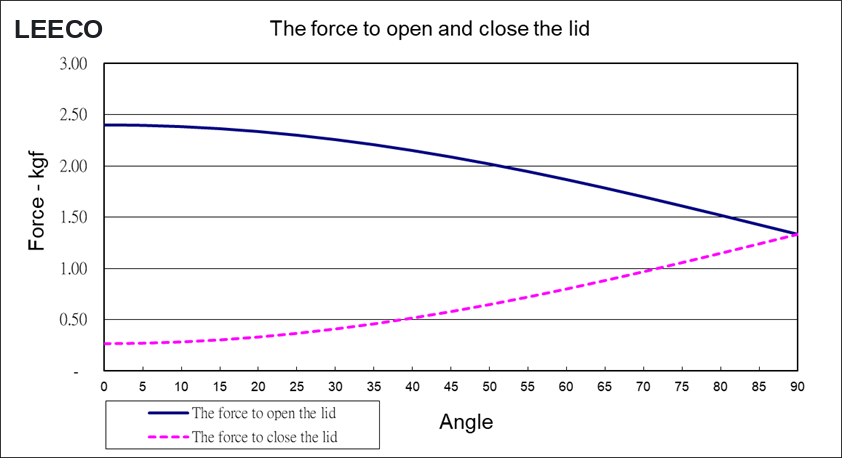
This is the hinge most engineers reach for first, mostly because it's the simplest to spec: the friction torque is identical whether the lid is opening or closing. We assumed a constant 40 kg·cm of friction.
| Angle | Calculation | Force |
|---|---|---|
| 0° (closed) | (32 + 40) / 30 | 2.4 kgf |
| 45° | (32 × cos45° + 40) / 30 | ≈2.09 kgf |
| 90° (fully open) | (32 × cos90° + 40) / 30 | ≈1.33 kgf |
At roughly 2.4 kgf to break the lid free from closed, this is the heaviest-feeling option of the four — noticeable if your end user is opening the lid dozens of times a shift.
02 Asymmetric Torque Hinge
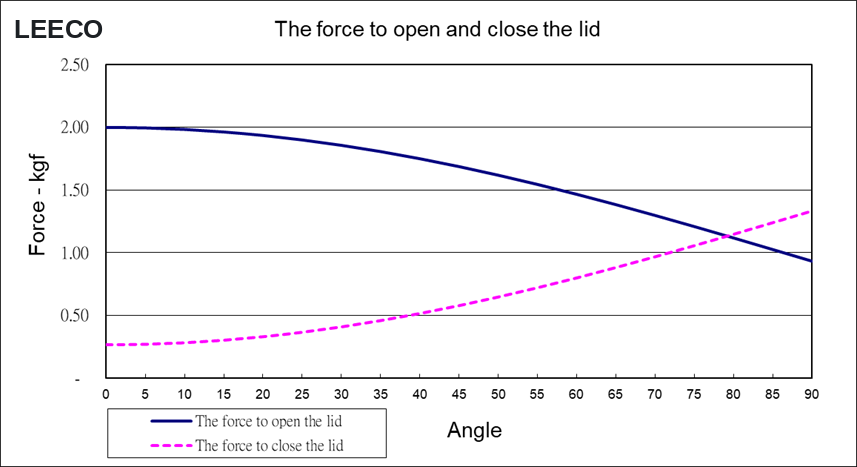
Asymmetric hinges split the friction budget between opening and closing, which is where things start getting genuinely useful for product design. We modeled a 28 kg·cm opening torque against a 40 kg·cm closing torque (the closing figure is included for reference — it doesn't factor into the opening-force math below, it just tells you the hinge will still hold the lid shut firmly).
| Angle | Calculation | Force |
|---|---|---|
| 0° | (32 + 28) / 30 | 2.0 kgf |
| 45° | (32 × cos45° + 28) / 30 | ≈1.69 kgf |
| 90° | (32 × cos90° + 28) / 30 | ≈0.93 kgf |
That's roughly a 17% reduction in initial opening effort compared to the symmetric hinge, without giving up any of the closed-position holding strength.
03 Asymmetric Hinge with Counterbalance Spring
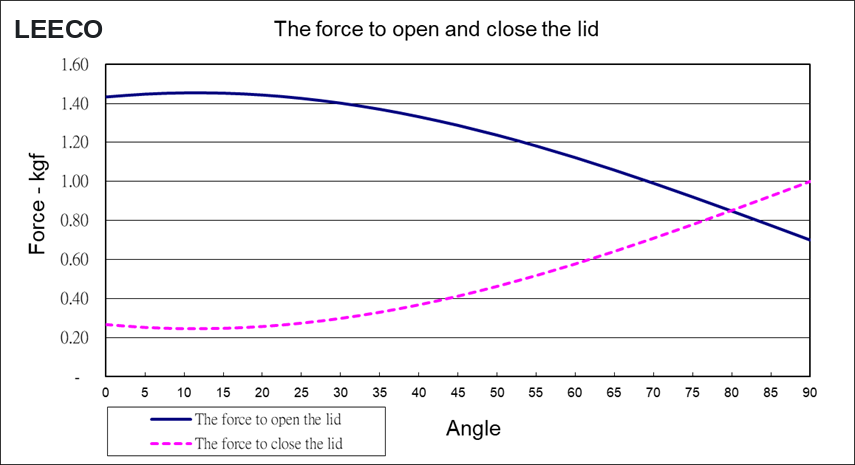
This is where friction hinge design starts overlapping with torque hinge engineering proper — a spring is added to actively push against gravity during the opening motion. We assumed a 21 kg·cm opening torque, a 30 kg·cm closing torque (again, reference only), and a spring contributing 10 kg·cm of assist at the closed position, tapering to zero by 90°.
| Angle | Calculation | Force |
|---|---|---|
| 0° | (32 + 21 − 10) / 30 | 1.43 kgf |
| 45° | (32 × cos45° + 21 − 5) / 30 | ≈1.29 kgf |
| 90° | (32 × cos90° + 21 − 0) / 30 | 0.7 kgf |
For this comparison, the spring's assist is modeled as decreasing in a straight line (10 → 5 → 0 kg·cm), which is a reasonable approximation for a torsion spring over this range, though real spring curves are rarely perfectly linear — something worth checking against the manufacturer's actual torque curve before you finalize a spec.
04 One-Way Friction Hinge
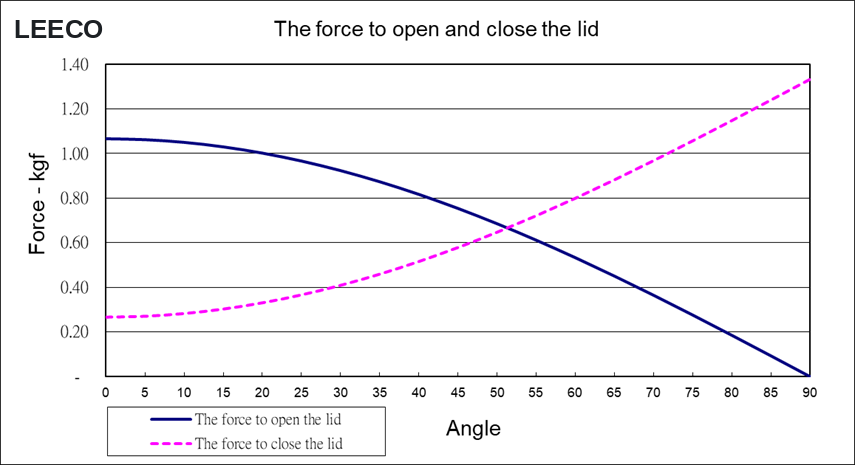
The one-way (or "one-directional") friction hinge is built for a single job: let the lid swing open with almost no resistance, then bite hard on the way closed. We assumed 0 kg·cm opening torque against 40 kg·cm closing torque.
| Angle | Calculation | Force |
|---|---|---|
| 0° | (32 + 0) / 30 | ≈1.07 kgf |
| 45° | (32 × cos45°) / 30 | ≈0.75 kgf |
| 90° | (32 × cos90°) / 30 | 0 kgf |
At 90°, the force drops to essentially zero — gravity alone is doing all the work by that point, and the hinge simply isn't adding any resistance to fight against.
So Which Hinge Is Actually Easiest to Open?
Across every angle we tested, the ranking stayed consistent — which is a useful sanity check that the underlying physics is behaving as expected rather than producing a fluke result at one specific point.
| Hinge Type | 0° | 45° | 90° |
|---|---|---|---|
| One-Way Friction Hinge | 1.07 kgf | 0.75 kgf | 0.00 kgf |
| Asymmetric + Counterbalance Spring | 1.43 kgf | 1.29 kgf | 0.70 kgf |
| Asymmetric Torque Hinge | 2.00 kgf | 1.69 kgf | 0.93 kgf |
| Symmetric Torque Hinge | 2.40 kgf | 2.09 kgf | 1.33 kgf |
One-way friction hinges win on opening force, hands down. But "easiest to open" and "right for your product" aren't always the same answer — and that gap is exactly where a lot of hinge specs go wrong.
Choosing Between Them: What Actually Matters for Your Application
A few things we've seen trip up engineers and buyers alike when they're picking between these four types:
- If your lid needs to hold a mid-swing position (think a laptop screen or an inspection panel that stays open at any angle), a one-way hinge is the wrong choice — it offers almost no resistance once opening, so the lid won't stay put anywhere except fully closed or fully open. A symmetric or asymmetric hinge (without the spring) tends to hold position more predictably across the range.
- If the lid is heavy and opened frequently by hand — server cabinets, industrial control boxes, medical equipment carts — the asymmetric-with-spring option is usually the sweet spot. It cuts initial opening effort nearly in half versus a symmetric hinge while still giving a firm, controlled close.
- If your product is opened one-handed, repeatedly, by the same person all day (packaging lines, POS terminal lids, vending equipment), the one-way hinge's near-zero opening resistance reduces repetitive strain over a full shift in a way the numbers above don't fully capture — this is where field feedback from actual operators tends to matter more than the spec sheet.
- Closing behavior still needs its own check. All four types here were compared purely on opening force, but a lid that opens easily and then slams shut under gravity is its own safety and durability problem. The closing torque figures we noted for each case (40, 40, 30, and 40 kg·cm respectively) are what actually control that side of the equation.
None of this replaces bench testing. Calculated torque and friction values are a starting point — actual hinge friction can shift with manufacturing tolerance, temperature, and wear cycles, which is why every hinge sample that comes through our line at LEECO gets pulled on a digital torque gauge before it's approved for a customer's BOM, not just checked against the datasheet.
Frequently Asked Questions
Is a friction hinge the same thing as a torque hinge?
In practice, yes — the terms are used interchangeably across most manufacturer catalogs. Some engineers reserve "torque hinge" for hinges with a specified, tested torque rating (as opposed to a hinge that simply has some incidental friction), but for sourcing and RFQ purposes, treat them as the same part category.
How do I calculate the opening force for my own lid?
Use the base formula: Force = (Gravitational Torque + Hinge Opening Torque − Spring Assist, if any) / Lid Height. You'll need your lid's weight distribution to estimate gravitational torque, and the hinge manufacturer's rated torque for the rest. If you're not sure how to measure your lid's actual torque requirement, a simple fish-scale-and-string test at the point of force application will get you a rough number before you commit to a hinge spec.
Which hinge type is best for one-handed operation?
The one-way friction hinge, based on the numbers above — it requires roughly 55% less force to initiate opening than a symmetric hinge. Just confirm your application doesn't need the lid to hold a mid-swing position, since one-way hinges typically won't do that.
Does hinge friction change over the life of the product?
Yes, to some degree. Friction hinges rely on mechanical contact (cam surfaces, friction clutches, or spring-loaded washers), and that contact wears over thousands of open/close cycles. Reputable manufacturers rate hinges for a cycle life (commonly 20,000–50,000+ cycles) at which torque is guaranteed to stay within a defined tolerance band — ask for this figure, not just the initial torque spec.
What torque range do I need for my specific product?
That depends on your lid's weight, dimensions, and how the force is applied — there's no universal number. As a starting point, most enclosure lids in the 20–40 cm range fall somewhere between 15–50 kg·cm of hinge torque, but undersized or oversized torque is one of the most common return/rework reasons we see, so it's worth having it calculated (or tested) against your actual part rather than estimated from a similar product.
Need help specifying the right hinge?
Send us your lid weight, dimensions, and application, and our engineering team will help you find or customize the right torque hinge.