How to Calculate Torque for Friction Hinge: What the Datasheets Don't Tell You
How to Calculate Torque for Friction Hinge: What the Datasheets Don't Tell You
I've watched an engineer spend three days debugging a drooping lid — the kind that slowly sinks shut over 20 minutes, never slams, never fully closes, just drifts. He'd calculated the torque correctly. He'd picked a hinge within spec. What he'd missed was eight meters of bundled cable behind the panel. This guide is about the calculation, yes — but more about the parts that don't fit on a formula card.
1. What a Friction Hinge Actually Does — And Why Most Engineers Misunderstand the Job
The standard explanation goes like this: a friction hinge uses internal resistance to hold a panel at any angle. That's technically accurate and almost completely useless for selection purposes.
Here's a better mental model. A friction hinge is not holding your panel — gravity is always trying to close it. The hinge is generating a counter-moment that slightly exceeds the gravitational moment at every point in the rotation. "Free-stop" positioning isn't a feature. It's what happens when you get that balance right across the full range of motion, at operating temperature, after 10,000 cycles of use, in whatever environment your product actually lives in.
That last part is where most specifications fall apart. A hinge that holds perfectly in a climate-controlled R&D lab may drift noticeably on a factory floor in August. I'm not saying this to be discouraging — I'm saying it because the formula alone won't tell you this, and the datasheet usually won't either.
When a standard hinge and a friction hinge look identical from the outside
A colleague once spec'd a standard barrel hinge for a diagnostic equipment lid because "it looked the same and was cheaper." Six months into production, warranty claims were coming in — lids that wouldn't stay open. The fix was a complete hinge swap during a service window. The cost was roughly 40x what the torque hinge would have added to the BOM. I've seen this particular mistake made twice in the same product category by two different teams. It's more common than anyone wants to admit.
The one thing that separates a good friction hinge spec from a bad one
It's not the torque value. It's the tolerance band around that value — and whether anyone on the team actually thought about what happens at the minimum of that band, after wear, in summer. If your answer to that question is "we picked 20% headroom and moved on," that's usually fine for office furniture. It's not fine for anything that gets shipped to Southeast Asia or sits next to a heat source.
2. The Core Formula — And the Variable Everyone Gets Wrong
Before reaching for a catalog, you need one number: the required holding torque at the worst-case angle. The formula is straightforward. What's not straightforward is measuring one of its inputs correctly.
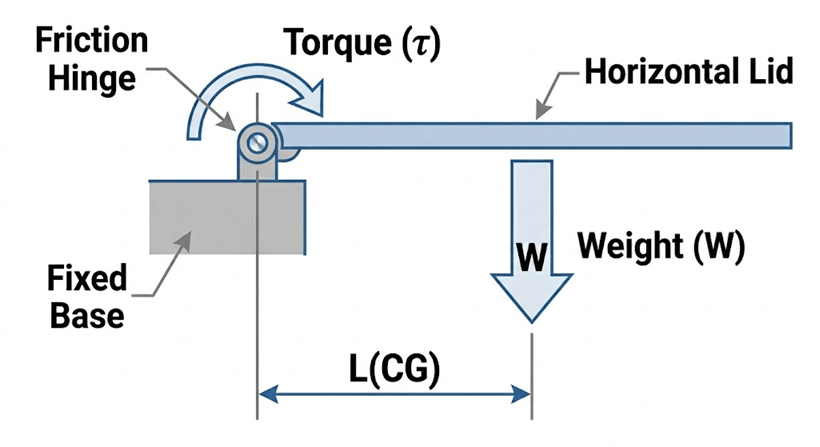
T = W x L(CG) x cos(θ) T = required torque (N·m) W = panel weight in Newtons [W = mass(kg) x 9.81] L(CG) = distance from hinge axis to center of gravity (meters) θ = angle from vertical (°) — peak torque at θ = 0° (panel horizontal)
Figure 1: Visualizing the variables in the torque formula. Peak torque occurs when the lid is horizontal (0°).
Step 01 — Weigh the complete assembly
Panel skin, glass, handle, gasket, hinge leaves, cable bundle, any internal bracket. Convert to Newtons: W = mass (kg) x 9.81. If you're weighing a prototype without its production cable run, add an estimate — bundles in equipment enclosures routinely add 0.3–0.8 kg that nobody put on the BOM.
W (N) = total mass (kg) x 9.81
Step 02 — Find L(CG) measured from the hinge rotation axis
This is the variable I've seen measured wrong more than any other. L(CG) is the distance from the hinge's pivot axis to the center of gravity — not from the panel's mounting edge. For a uniform panel: L(CG) = height / 2. For non-uniform assemblies use: L(CG) = Sum(mi x di) / m_total
L(CG) = [m1*d1 + m2*d2 + ...] / m_total
Step 03 — Identify the peak angle
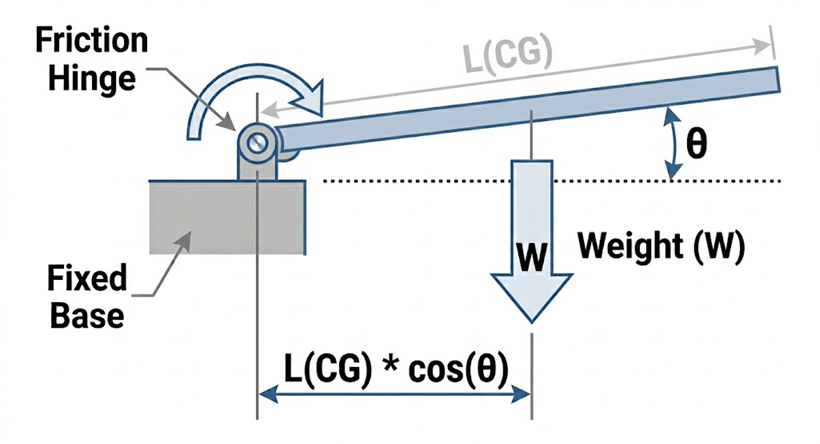
Peak torque occurs when the panel is horizontal: angle = 0 degrees from horizontal, cos(0) = 1.0. If you want self-closing below 15 degrees, design for cos(15) = 0.97. The difference is small here, but matters at steeper self-close angles. Figure 2: Understanding the cosine effect. As the angle θ increases, the horizontal distance to the CG decreases, reducing the required torque.
Step 04 — Divide by number of hinges (with a caveat)
In theory, two hinges share load equally. In practice, if mounting surfaces aren't coplanar within 0.1 mm, one hinge carries 60–70% of the torque. For production-scale designs, I'd recommend calculating with n = 1.5 x (number of hinges) as a buffer for assembly variation.
T(req per hinge) = (W x L(CG) x cosθ) / n
3. Three Examples — One Clean, One Messy, One That Almost Went Wrong
I've deliberately made these unequal. The laptop case is short because it's genuinely simple. The industrial enclosure case is long because that's where the real complexity lives — and where I've personally spent the most time debugging.
[Example A] Laptop display — the straightforward case
Display + lid mass
0.42 kg → W = 4.12 N Panel height, L(CG)
280 mm, L(CG) = 0.14 m (uniform) Hinges / angle
2 hinges, θ = 0°, cos(0°) = 1.0 T(req per hinge)
0.29 N·m
Production laptop hinges typically run 0.35–0.55 N·m — roughly 1.2–1.9x above this baseline. The upper end of that range isn't safety margin, it's deliberate ergonomic feel. Users subjectively rate heavier-feeling screens as higher quality, and OEM teams tune for this. It's one of the few places in engineering where the "correct" torque is partly a perception decision.
[Example B] Cabinet lid with off-center glass — where the textbook answer misleads you
Panel (0.9 kg at 225 mm)
+ Glass (0.5 kg at 180 mm) + Handle (0.3 kg at 420 mm) L(CG) recalculated
(0.9x225 + 0.5x180 + 0.3x420) / 1.7 = 237 mm = 0.237 m W = 1.7 x 9.81
16.7 N T(req per hinge) = (16.7 x 0.237 x 1.0) / 2
1.98 N·m
The lesson wasn't "calculate more carefully." It was: always build and weigh a physical assembly before finalizing hinge spec. CAD models are systematically optimistic about component weight, especially for off-the-shelf hardware.
[Example C] Industrial enclosure door — the one that nearly caused a field recall
Door panel + hardware
5.2 kg → W = 51.0 N L(CG)
0.30 m (uniform, 600 mm door) Cable bundle drag force
~11 N (8 cables, 12 mm diameter each) EPDM gasket compression
~6 N at full close Effective W (total)
51.0 + 11 + 6 = 68 N Corrected T(req per hinge) = (68 x 0.30 x 1.0) / 2
10.2 N·m
We'd selected exactly 10 N·m hinges. The corrected calculation showed we were already at the rated limit before applying any safety factor. The fix was upgrading to 13 N·m units — a two-week delay. Had this gone to field install first, we would have been looking at a service campaign across 200+ units in outdoor enclosures. Cable drag is the most consistently underestimated load in enclosure hinge applications.
4. Safety Factor and Tolerance: The Number the Datasheet Buries in Footnotes
Every friction hinge torque rating has a tolerance band — usually ±15% to ±25%. This is one of the most consequential numbers in hinge selection and it's typically in a footnote, if it appears at all. What it means: a hinge rated at 2.0 N·m might deliver 1.5 N·m on a cold day after two years of use. If your door moment is 1.8 N·m, you have a problem that won't show up in lab testing.
Why I'm skeptical of any safety factor guide that gives you a single number
The 1.2–1.5x range you'll see everywhere is a reasonable starting point. But that range was developed for ambient conditions and moderate cycle life. It doesn't account for thermal creep (polymer friction pads softening at 50°C+), for gasket-induced load spikes, or for the fact that "50,000 cycle" specifications are sometimes tested at significantly lower than rated torque. My personal threshold: if a manufacturer can't tell me at what torque load their cycle life figure was tested, I add 0.2 to whatever safety factor I was planning to use.
Pro Tip Practical rule that isn't in any datasheet: for polymer-pad friction hinges going into environments above 45°C, request the torque-vs-temperature curve, not just the room-temperature rating. If the manufacturer doesn't have one, that tells you something important about how the product was validated.
The ±20% tolerance band in practice
For a hinge with ±20% tolerance, your selected rated torque must satisfy: rated torque x 0.80 > T(peak). Minimum rated torque = T(peak) / 0.80 = 1.25 x T(peak). Then apply your environment factor on top:
- Indoor, stable temperature: 1.3x total safety factor
- Temperature-variable or vibration environments: 1.5x
- Medical or safety-critical applications: 1.5x minimum, verify cycle life at actual operating torque
While the 1.2 to 1.5 safety factor is a good rule of thumb, specific cycle-life requirements under varied temperatures can demand a custom torque profile. If your application involves critical safety or premium feel, contact our engineering team for a validated FEA (Finite Element Analysis) torque model.
5. Selecting the Right Model: What I Actually Look at in a Datasheet
After you have T(design), you're comparing it against catalog specs. Here's what I look at, in order of importance — which is not the same order that catalog pages present information.
1. Torque at operating temperature, not room temp. Ask specifically if you're in a warm environment. The difference between 20°C and 50°C can be 15–25% for polymer-interface hinges.
2. Cycle life tested at what torque load? A hinge rated for 50,000 cycles tested at 20% of its max torque is a very different product from one tested at 80%. This detail is rarely in the standard datasheet — you have to ask.
3. Torque curve shape (constant vs. rising vs. falling across angle). Most friction hinges deliver constant torque. Some have a slight rise near closed position — affects feel and changes your angle-based calculations.
4. Adjustable vs. fixed torque: I'd only use adjustable hinges when load genuinely varies or during prototyping. The set-screw mechanism is a potential loosening point in vibration environments.
5. Mounting surface requirements: flatness tolerance for the mounting surface determines whether a two-hinge system shares load or one hinge does all the work. I use 0.1 mm as my working standard.
6. Three Failure Modes — Ranked by How Often I've Actually Seen Them
These aren't hypothetical. They're ordered by frequency in real projects, not by severity.
M1: Cable drag and gasket force omitted — the most common by far
In roughly half the enclosure hinge projects I've reviewed, the torque calculation was done on the bare panel weight with no additional loads. Cable bundles, routing clips, gasket compression — all missing. The symptom is a hinge that tests fine on the bench and droops in the field, usually after installation adds the wiring. Fix: always calculate with a physical assembly that includes production-representative cabling.
M2: Torque decay from temperature dismissed as "within spec"
I've seen this particularly in products that go through climate testing late in development. The hinge passes room-temp hold tests, goes through 60°C thermal cycling, then gets retested. Torque is down 18%. Engineering says "still above minimum." Product ships. Eighteen months later, field returns start coming in from warmer geographies.
M3: Mounting misalignment — less common, hardest to diagnose
When one hinge of a two-hinge system wears significantly faster than the other, misalignment is almost always the cause. Verify coplanarity during installation qualification, not just in the design.
Design Consideration
Standard Tier 1 Brands
Leeco Tech’s Engineering Advantage
Datasheet Accuracy
Theoretical values; "ideal" lab conditions only.
Empirical validation including secondary load accounting.
Thermal Stability (50°C+)
Standard polymers soften; high risk of lid "drifting" in warm environments.
Specific material selection for minimal torque decay at high operating temps.
Secondary Load Forces
Often ignored (cables, gaskets, wind).
Calculates cable drag & seal compression as critical inputs.
Prototyping & Customization
Rigid catalogs; high MOQs for torque adjustment.
Rapid custom profiling with flexible MOQ for NPI stages.
Note: Technical comparisons are based on internal application testing and comparative material analysis.
7. FAQ — Frequently Asked Questions
Q1: N·m or kgf·cm — does it actually matter which I use?
Use N·m. It's ISO standard (ISO 80000-4) and what every major manufacturer publishes in current datasheets. If you're working from legacy specs in kgf·cm: 1 kgf·cm = 0.0981 N·m, so 10 kgf·cm ? 1 N·m. The risk is mixing units mid-calculation, which I've seen happen more than once on multi-engineer projects.
Q2: How do I know if I need one hinge or two?
If a single hinge in your size range can deliver your T(design), one is mechanically sufficient. In practice, use two for panels wider than 400 mm regardless of torque requirement — single-hinge panels twist under off-center loading, stressing the hinge mount in ways the torque calculation doesn't capture. If smooth motion or ergonomics is your main priority, you might want to check out another article from LEECO: FRICTION HINGE VS. TORQUE HINGE: A FORCE ANALYSIS (WITH REAL CALCULATIONS).
Q3: Is vertical-axis (door) different from horizontal-axis (lid)?
Same formula, different behavior. A truly vertical-axis door has a gravitational moment that's essentially constant with angle. Most hinge selection errors on doors are about underestimating wind load, not gravity moment.
Q4: My friction hinge held fine for 6 months. Now it's drooping. What happened?
Three likely causes: (1) friction surface wear — hinge was near its minimum torque and normal wear pushed it below; (2) the environment got warmer seasonally; (3) mounting surface shifted from thermal cycling. Measure actual torque with a gauge. If it's dropped more than 20% from rated, replace. If less, investigate environment first.
Q5: Are there calculators that do this automatically?
Yes. LEECO's calculator handles the cos(θ) formula directly at https://leecotech.com/torque-calculator.html. Use it to cross-check your manual calculation — no online calculator accounts for cable drag or gasket compression. Calculation looks complex? Our engineers can do it for you.
Bottom line The formula is simple. The hard part is getting accurate inputs — especially total panel weight with all production components, actual center of gravity for non-uniform assemblies, and any additional forces beyond gravity. Apply a safety factor appropriate to your environment (1.3x minimum for anything that isn't office furniture), verify at operating temperature, and check that your cycle life spec was tested at something close to your actual operating torque. Do those four things and your friction hinge will outlast the product it's installed in.
About This Article
This article was written by the engineering team at LEECO.
If you have any questions or need support with hinge selection, feel free to contact us — our team is ready to help.