
I spent eleven years at Southco promoting and developing friction hinge markets globally before joining LeecoTech in 2007. The products were good. The gap I kept seeing wasn't in the hardware — it was in what happened between the datasheet and the engineer's actual application.
Most customers either don't know how to select the right friction hinge for their specific requirements, or they rely on their own interpretation of the specs and install it based on that understanding alone. At LeecoTech, the first thing we changed was the response model: every customer inquiry gets a substantive reply within 24 hours, with a specific hinge recommendation and the reasoning behind it — not a catalog link.
That single change is responsible for more successful applications than any product update we've made. This article is a written version of what we walk customers through in those early conversations.
What a One Way Friction Hinge Is — and What It Isn't
A one way friction hinge holds a panel in position against gravity in one rotational direction, while offering near-free movement in the opposite direction. Open a laptop, position the screen where you want it, let go — it stays. That's the behavior.
What it is not is a hinge that holds against force from both directions. This distinction matters more than it seems.
We see a pattern: engineers will spec a one-way hinge on a lid that opens upward, which is correct, and then realize during testing that if someone leans on the open lid from above, it folds. They interpret this as the hinge failing. It isn't. The one-way design is working exactly as intended — it was never meant to resist force in the free direction. If you need resistance in both directions, that's a two-way hinge, and we'll cover when that's actually worth the extra cost.
The internal mechanism that makes this work is a clutch assembly — friction elements that engage in one direction and release in the other. Our OW10, for example, uses a steel-and-grease clutch that provides full torque in either the CW or CCW direction (customer specifies at ordering), while the opposite direction turns freely.
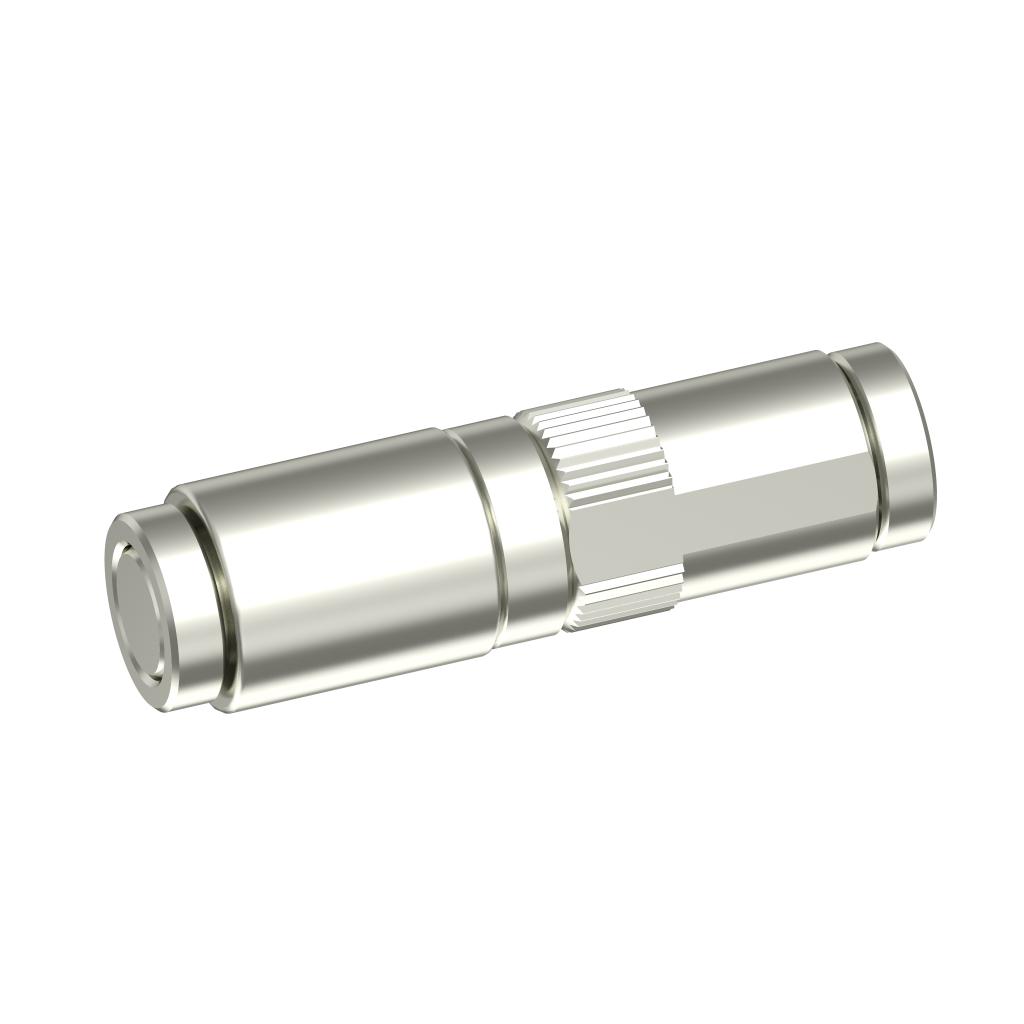
LeecoTech OW10 one way friction hinge. Dimensions: 10 × 10 × 34.80 mm. Available in six torque steps: 0.5, 0.75, 1.0, 1.25, 1.50, and 2.0 N·m. Steel construction, RoHS/REACH compliant.
The key phrase is at ordering — this is not a field-adjustable feature. You pick the direction when you design the mounting, and you verify it against your technical drawing before the parts ship.
One thing worth mentioning here: some applications require torque behavior that's different in the first portion of the rotation versus the latter — what engineers sometimes call a two-stage torque profile. We had a customer come to us with exactly this requirement, and no off-the-shelf solution fit it. That problem led directly to a new internal mechanism design, which we developed, validated, and ultimately filed as a US patent. It's one of the three patents in our current portfolio. I raise it not to sell that specific product, but to illustrate that the standard one-way clutch behavior doesn't cover every use case — and if your application has unusual torque requirements across the rotation arc, it's worth describing that to us in detail before assuming a standard catalog part will work.
How it compares to other types
| Type | Torque Behavior | Closing Method | Relative Cost |
|---|---|---|---|
| One-way | Holds in one direction only | Gravity-assisted | +30–50% |
| Two-way | Holds in both directions | Manual or motorized | Baseline |
| Detent | Locks at preset angles | Gravity or manual | Similar to two-way |
| Standard pivot | No resistance | Any | Lower |
The 30–50% cost premium for one-way is real, and in our view, it's worth it when the application genuinely needs directional torque control. If your panel closes under gravity and the user only ever pushes it open — not down — one-way delivers a better user experience despite the higher unit cost. We tell customers this even when it means they pay more for the right part.
The Direction Problem — More Complicated Than the Catalog Shows
We need to spend more time on this than most articles do, because it's where things go wrong.
A one way friction hinge has a free direction and a torque direction. The torque direction should resist gravity's pull on your panel. For a lid that opens upward (hinge axis horizontal at the back), gravity tries to close it — so the torque direction must resist closing. Straightforward.
The complication is how CW and CCW are defined. They're defined when looking at the shaft from a specific end — and which end is "the viewing end" depends on how the hinge is oriented in your assembly. This is not a theoretical problem. We've had customers misread the CW/CCW direction on our drawing, install accordingly, and only discover the error when the panel behaved the wrong way in testing. The result: a new sample request and a full repeat of the pilot run — weeks of lost time, entirely preventable.
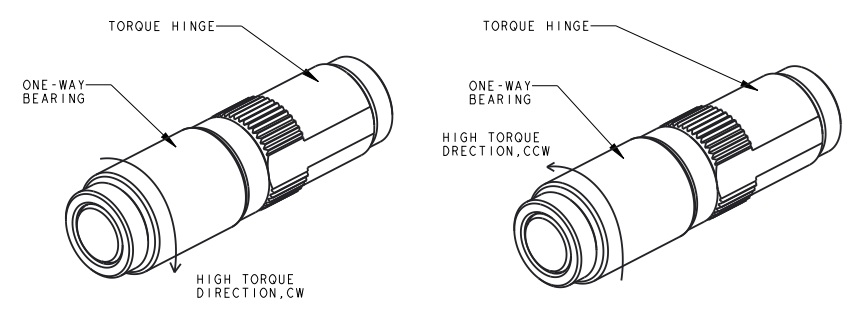
OW10 torque direction reference. Left: High Torque Direction = CW (clockwise). Right: High Torque Direction = CCW (counterclockwise). Always confirm which orientation matches your assembly before production.
That's why our OW10 technical drawing shows both viewing orientations explicitly. If a supplier's drawing doesn't show this, ask for clarification before assembly begins — not after.
The practical check is simple: mount one hinge on a test fixture, apply it to a panel mockup, and physically confirm that the panel holds at multiple angles and closes with minimal resistance. Do this before you finalize your assembly line setup, not during production.
It sounds obvious. We still see it skipped.
One Way or Two Way — How We Actually Make This Decision With Customers
The question we hear most often isn't "how does a one way friction hinge work" — engineers can find that anywhere. The question is: "should I use one-way or two-way for my application?"
If the panel closes under its own weight, one-way is almost always sufficient. The free direction (the "easy" direction) is the closing direction, so gravity helps close the panel without fighting the hinge. This covers most cabinet lids, access panels, and display mounts.
If the panel needs to hold against force from above or below — a horizontal shelf that someone might press down on, a display that could get bumped upward — that's where two-way earns its cost. The extra friction pack resists in both directions.
If your main concern is the panel drifting open from vibration, one-way may still be sufficient depending on the vibration axis, but we'd want to know more before making that call. This is one of those cases where "it depends" is the honest answer.
One scenario where we actively advise against one-way: horizontal overhead panels that users pull down to access. The math works, but the opening force requirement often makes the panel feel stiff and unintuitive to use. A two-way hinge or a gas strut may serve better.
One more pattern worth noting from experience: one-way friction hinges are particularly well-suited for applications where the rotation range is around 90 degrees. That geometry puts the maximum gravitational moment exactly at the open position, which is where you most need the hinge to hold. Applications requiring 120° or 180° of travel aren't disqualified, but they need more careful torque analysis across the full rotation range.
Torque Calculation — the Formula, and the Part the Formula Doesn't Tell You
The calculation for required holding torque is straightforward:
T = m × g × d × sin(θ)Where m is panel mass (kg), g is 9.81 m/s², d is the distance from hinge axis to panel center of gravity (m), and θ is the angle from vertical (90° = horizontal panel, worst case).
For a 2.0 kg lid, center of gravity 150 mm from the hinge axis, opened to 90°:
// Step 1 — gravitational torque at 90° T = 2.0 × 9.81 × 0.150 × sin(90°) = 2.94 N·m (total) // Step 2 — divide across two hinges T per hinge = 2.94 ÷ 2 = 1.47 N·m // Step 3 — apply 25% safety margin T specified = 1.47 × 1.25 = 1.84 N·m → Select OW10 at 2.0 N·mThe formula is the easy part. What the formula doesn't tell you is how torque behaves at the temperature extremes, what happens after 30,000 cycles, or how much the operator's pushing habits add to the load.
On temperature: our OW10 is rated −20°C to 65°C. At the cold end, grease viscosity increases and the hinge feels slightly stiffer. At the hot end, friction coefficient decreases. If your application regularly runs near 65°C, size up to the next torque step rather than specifying exactly at your calculated minimum.
On wear: the OW10 maintains torque within ±20% over 50,000 cycles. That means if you specify at exactly the required torque, you could be at 80% of nominal at end of life. Treat end-of-life torque (rated × 0.8) as your actual working floor.
On operator feel: calculated torque gives you what's needed to hold the panel statically. Users who push panels with more force than gravity add dynamic load. A 20–30% margin handles most real-world usage patterns.
There's another reason to run a higher safety factor on one-way hinges specifically that most torque guides don't mention. When a lid is pulled downward quickly, the effective torque demand increases with closing speed. If the torque is set too low, the lid doesn't just drift: it accelerates under its own weight and slams shut. A higher holding torque creates enough resistance to slow that motion and give the user tactile feedback that they're closing something, not dropping it. So on one-way applications, I generally prefer to err toward the higher torque step — not just for end-of-life headroom, but for the closing feel from day one.
Where One Way Friction Hinges Work Well — and Where We've Seen Them Struggle
Medical equipment is where we see the most careful procurement. A display mount on an imaging cart gets adjusted dozens of times per shift by clinicians managing a patient. The one-way behavior is exactly right: lift the screen easily, let go, it stays. Our OW10's steel construction holds up to standard cleaning protocols, and RoHS/REACH compliance is typically required for hospital procurement.
What we've learned from medical customers: they often underestimate how much force their users apply. A nurse in a hurry grabs the monitor housing, not the adjustment point, and applies force at an angle. Specify with a 30% margin on medical equipment, not 20%. That said, 30% is still a rule of thumb — we've had medical customers come back after field deployment saying even that wasn't enough for their particular workflow. The honest answer is to get a unit into the hands of real users before committing to a production torque spec.
Industrial enclosures are where we see the most installation errors. The most reliable mitigation isn't better training — it's better assembly drawings. If your drawing shows the hinge as a rectangle with an arrow and the word "CCW," it will get installed wrong eventually. Show the full technical drawing with both possible orientations and which one is correct for your assembly.
The OW10's 10 × 10 × 34.80 mm footprint integrates cleanly into standard DIN rail enclosure profiles. For lids heavier than 5 kg, mount hinges at both lateral edges of the panel — asymmetric placement creates uneven wear and shortens cycle life meaningfully.
Consumer electronics is where the OW10's compact form is most valuable, but also where we're sometimes the wrong answer. If your product needs a hinge that's 2.5 mm in diameter or integrates into a 7 mm barrel design, we have those — they're different products in our line. For miniaturized electronics, the right conversation starts with your space constraint, not the torque spec.
Marine and coastal environments deserve separate mention, because the failure mode is different from anything on the list above. Corrosion, chloride exposure, and water ingress attack the friction elements directly, degrading torque in ways that don't show up until the hinge has been in service for a season. Standard steel and zinc alloy constructions are not appropriate here.
For marine applications, the material specification needs to start with SS316 stainless steel — not SS304, which is adequate for mild outdoor exposure but insufficient for salt spray. For hinges that will see direct water contact or submersion risk, an O-ring seal at the shaft is required to protect the internal friction mechanism. We've supplied SS316 friction hinges with integrated O-ring seals for vessel equipment and coastal installations, and the spec conversation always starts the same way: chloride level, temperature range, and expected IP rating. Get those three parameters clear before selecting any hinge for marine use.
Four Things We See Go Wrong — From Actual Customer Support Cases
We get support inquiries. Here's what actually shows up.
We had a custom product customer report exactly this — their friction hinges were fracturing after several months of use. We requested the returned samples and ran a full analysis. The hinge itself was structurally intact. What was actually failing was the customer's mounting bracket — a separate component that LeecoTech hadn't designed or supplied.
We could have stopped there. The hinge passed. But we ran a full lifecycle test on the hinge anyway, documented the results, and then looked at the load path going into the bracket. Our recommendation: increase the bracket wall thickness by 25%. The customer agreed, updated their design, and we ran another lifecycle test on the combined assembly to confirm. The fracture issue never recurred.
I mention this not because bracket failures are our responsibility — they aren't — but because this kind of problem shows up disguised as a hinge problem. If your hinge is visually intact but the assembly keeps failing, look at everything the hinge is loading, not just the hinge itself.
Springback. The internal spring pre-load that generates holding torque also creates a small restoring force near the closed position. Most applications don't care — the panel sits at 2–3° open, which is visually negligible. If your application has an IP seal or a latch that requires full contact at closure, you need a detent at 0°, not just a friction hinge. The OW10 is designed with minimal springback, but "minimal" is not "zero" — be explicit with us about your closure requirement when you inquire.
Over-specified torque. There's a real tradeoff between holding performance at end-of-life and opening feel at day one, and sometimes the safety margin advice in this very article is what caused the problem. If the panel genuinely requires significant effort to lift, drop to the next torque step — the holding margin is almost certainly still adequate.
This one we'll be honest about: we don't have a clean universal answer, and these cases take the most back-and-forth to resolve.
A one way friction hinge provides constant torque regardless of angle — the physics genuinely don't change with shaft position. So when someone reports angle-dependent holding, something else is going on. The two most common culprits: the panel's center of gravity shifts as it opens (common when there's a cable bundle, heavy display, or counterweight), or the two hinges aren't perfectly coaxial and one is binding. Both are real, both are fixable, but diagnosing which one remotely is difficult. A short phone call with dimensions and a photo of the assembly gets you to an answer faster than a thread of emails.
Frequently Asked Questions
Is the OW10 adjustable after installation?
What's the practical difference between a 1.5 N·m and 2.0 N·m OW10?
Can I use one OW10 instead of two?
What's the right torque if my panel has a gas strut or counterweight?
Does LeecoTech offer custom torque values outside the standard range?
Ready to Specify the Right Hinge?
If you're in early-stage design and still figuring out whether one-way is the right direction, our engineering team is available to talk through your application. We'd rather have a 20-minute conversation now than help you troubleshoot a batch return later.